
DME Billing Services for Medicare Claims, Rentals, Refills, Denials, and AR Recovery
DME billing services manage the complete revenue cycle for durable medical equipment and DMEPOS suppliers — from written order validation and prior authorization through HCPCS coding, modifier selection, rental sequencing, refill documentation, proof of delivery, claim submission, payment posting, denial management, and AR recovery. Medicare DME claims require a valid standard written order, medical necessity documentation, the correct HCPCS code and modifier, proof of delivery, and rental or refill controls matched to the item's payment category. Errors at any step generate preventable denials that delay or eliminate reimbursement.
ClaraRCM provides DME billing services for U.S. durable medical equipment and DMEPOS suppliers across all 50 states. Our team manages eligibility, written orders, face-to-face documentation, prior authorization, HCPCS codes, modifiers, proof of delivery, rental claims, refill documentation, payment posting, denials, and aging AR.
Updated July 2026 for current DMEPOS fee schedule files, written order requirements, face-to-face timing, rental logic, refill controls, and Medicare documentation rules.
Get a Free DME Billing Audit
Identify gaps in orders, authorization, modifiers, delivery evidence, rental sequencing, refills, denials, and AR — at no charge.
DME Billing Services: Written Orders, HCPCS Codes, Rentals, Refills, and Denial Management
DME billing services manage the complete revenue cycle for durable medical equipment, prosthetics, orthotics, and supplies. The process begins before delivery — with written order validation, eligibility verification, and prior authorization — and continues through HCPCS coding, modifier selection, claim submission, payment posting, rental continuation, refill documentation, denial resolution, and AR recovery. Every step must connect for a clean Medicare claim to reach the payer and pay correctly.
Medicare DME claims depend on documentation that supports both coverage and medical necessity. A correct HCPCS code alone is not enough. The written order, practitioner record, required face-to-face encounter, prior authorization, proof of delivery, and claim details must all describe the same item and the same patient need. Missing any one element generates a preventable denial that takes significant staff time to resolve.
ClaraRCM validates supplier enrollment, patient eligibility, item coverage, HCPCS and diagnosis alignment, modifiers, quantity, rental month, proof of delivery, refill timing, remittance posting, and open AR before revenue is left unresolved. Explore our denial management services, AR follow-up, eligibility verification, and claim submission services.
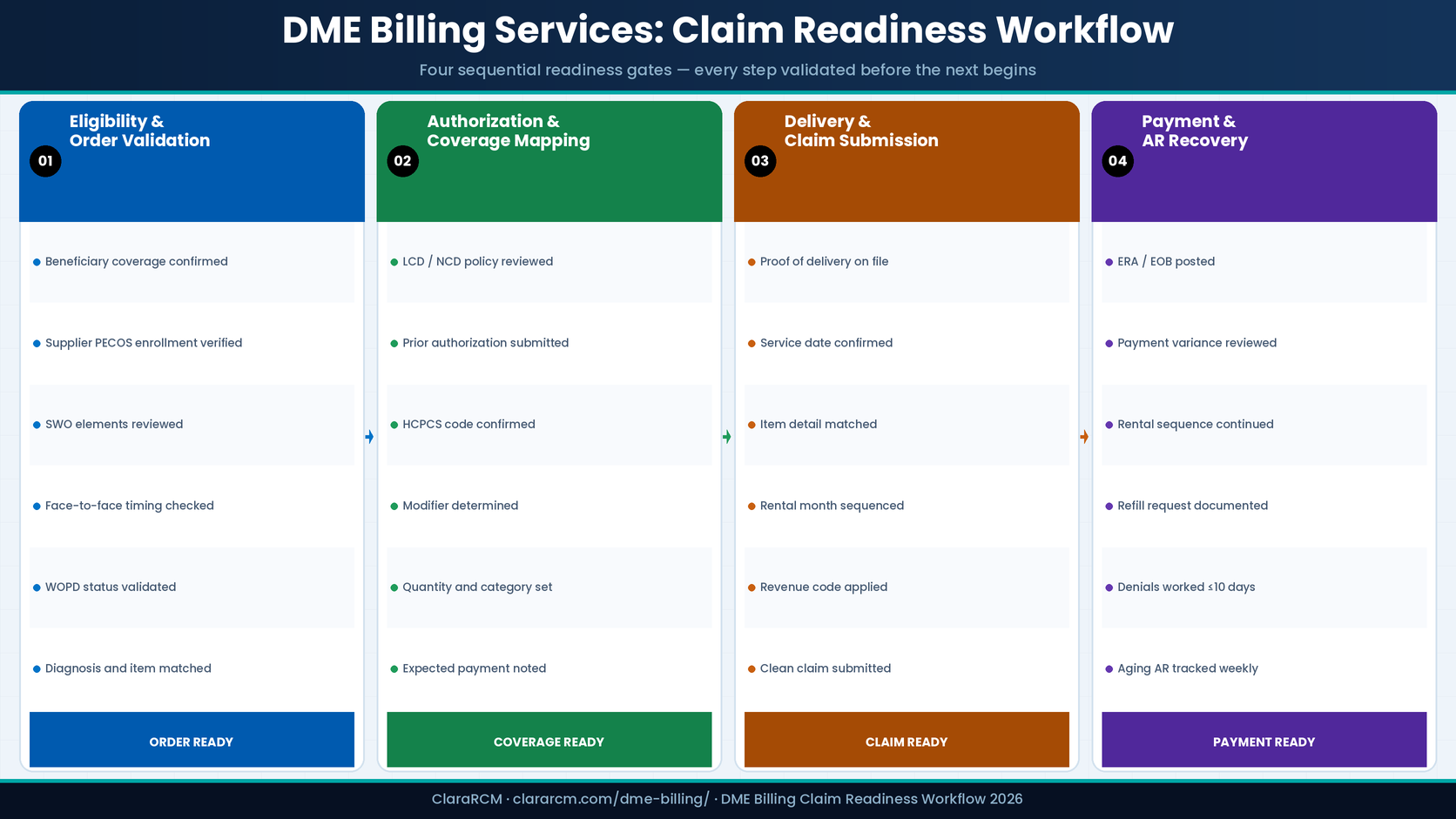
ClaraRCM's DME billing workflow: four sequential readiness gates — Order Ready, Coverage Ready, Claim Ready, and Payment Ready — with every step validated before the next begins.
| DME Billing Problem | ClaraRCM Control |
|---|---|
| Order incomplete, unsigned, or mismatched to delivered item | SWO element review before delivery or claim release |
| Required face-to-face encounter or WOPD missing | Item list, encounter date, order date, and delivery date validation |
| HCPCS, diagnosis, modifier, or quantity does not support coverage | LCD, NCD, payer policy, and claim line review at submission |
| Rental months billed with wrong sequence or modifier | Patient-level rental ledger with KH, KI, KJ, and RR controls |
| Proof of delivery does not match the claim | Item, quantity, recipient, delivery date, and tracking reconciliation |
| Refills shipped without documented beneficiary request | Refill contact, remaining supply, shipment date, and claim hold controls |
DME Rental and Refill Revenue Leakage Calculator
Estimate annual revenue exposure from delayed or denied rental claims and refill orders that do not become payable claims. Enter your numbers and send the results to ClaraRCM for a free audit.
Estimated annual exposure from unrecovered rental issues and missed refill revenue.
Starting values are illustrative. Actual exposure depends on item mix, payment category, locality, payer contracts, rental sequence, refill frequency, documentation, and appeal success rate.
Send Your Results to ClaraRCM
Our team reviews your rental and refill inputs and identifies practical control points for your program.
DME HCPCS Codes With 2026 Medicare Payment Direction
The ranges below are rounded planning estimates from public Medicare DMEPOS fee schedule direction. Actual payment varies by state, locality, item category, rental month, modifier, and payer contract. Verify every amount in the current CMS file before billing. Last updated: July 2026.
| HCPCS | Description | 2026 Medicare Direction | Billing Control Point |
|---|---|---|---|
| E0601 | CPAP device | ~$45–$75/rental mo. | Sleep study, order, continued coverage, RR modifier, rental sequence |
| E0470 | Respiratory assist, no backup rate | ~$90–$160/rental mo. | Diagnosis, testing, device type, continued use evidence |
| E0471 | Respiratory assist, with backup rate | ~$200–$360/rental mo. | Device distinction documentation; higher medical necessity bar |
| E1390 | Stationary oxygen concentrator | ~$80–$145/rental mo. | Qualifying oxygen test, order, oxygen need, rental cap tracking |
| K0001 | Standard manual wheelchair | ~$35–$70/rental mo. | Mobility limitation, home use, accessories, rental sequence |
| E0260 | Semi-electric hospital bed | ~$80–$140/rental mo. | Positioning need, home use, accessory docs, delivery proof |
| E0143 | Folding walker with wheels | ~$70–$115 purchase | Mobility need, item configuration, proof of delivery |
| A4239 | CGM monthly supplies | ~$200–$300/month | Refill request, supply period, eligibility, timely shipment |
| E2103 | CGM receiver device | ~$150–$260 purchase | Device pathway, order, beneficiary eligibility, delivery proof |
| A5500 | Diabetic shoe, custom fitted | ~$70–$115 each | Certifying practitioner, diabetes coverage, fitting, quantity |
| A5513 | Custom molded diabetic insert | ~$45–$85 each | Insert type, quantity, documentation, delivery date |
| L1833 | Knee orthosis, adjustable joint | ~$450–$850 purchase | Brace configuration, diagnosis, prior authorization, delivery |
Ranges are deliberately broad. The July 2026 CMS file includes jurisdiction and payment category fields that apply to the exact claim. Verify at the CMS DMEPOS Fee Schedule.
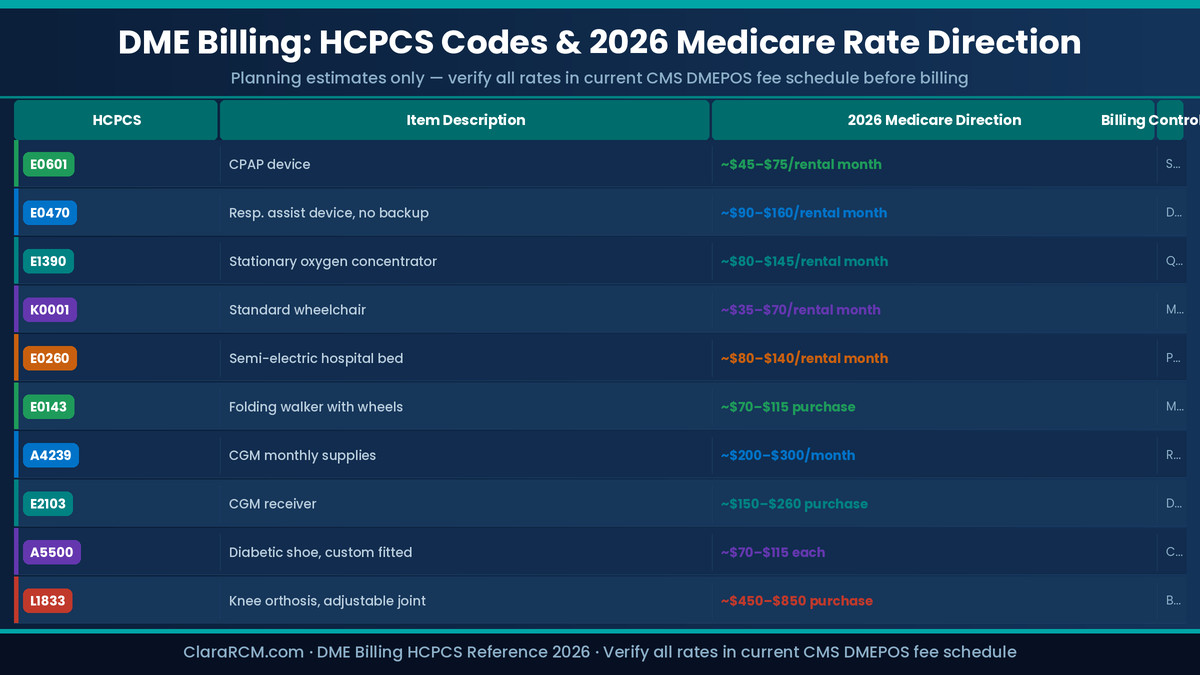
Key HCPCS codes for DME billing with 2026 Medicare payment direction and the billing control point for each. Verify actual rates in the current CMS DMEPOS fee schedule file before submitting any claim.
How ClaraRCM Manages DME Billing: 4 Steps
Eligibility and Order Validation
We verify beneficiary coverage, supplier enrollment, item benefit category, diagnosis, SWO elements, practitioner record, face-to-face timing, and WOPD status before any claim is released. See our eligibility verification services.
Authorization and Claim Mapping
We review LCD, NCD, and payer policy; confirm prior authorization; select the HCPCS code, modifier, quantity, and rental or purchase path; and verify expected payment before submission through our medical coding support.
Delivery and Claim Submission
We connect proof of delivery, service date, item detail, rental month, and refill evidence, then submit a clean claim daily via our claim submission services.
Payment Posting and AR Recovery
We post remittances, reconcile expected vs. posted payment, correct and appeal denials, track rental continuation and refill claims, and work aging AR through our payment posting and AR follow-up services.
Why DME and DMEPOS Suppliers Choose ClaraRCM
Order Before Delivery Control
We connect SWO, face-to-face encounter, WOPD timing, authorization, and delivery sequence before an avoidable denial reaches the payer — not after.
Rental Sequence Expertise
We track monthly rental claims, KH, KI, KJ, RR, continued need documentation, capped rental status, replacement logic, and supplier changes at the patient level.
Refill Documentation Control
We reconcile beneficiary requests, remaining supply, shipment timing, quantity, delivery records, and recurring claim release for every refill order.
HCPCS and Modifier Accuracy
We match the item, diagnosis, condition, payment category, quantity, modifier, and payer rule at claim line level — catching errors before submission, not after denial.
Payment Variance Reporting
Leadership receives expected payment, posted payment, denial, underpayment, rental, refill, and aging AR views in one consolidated monthly workflow report.
Nationwide U.S. Coverage
ClaraRCM supports 500+ providers across all 50 states from our U.S.-based team — payer-focused billing with dedicated account management and responsive communication.
DME Billing Results: Before ClaraRCM and After
| Revenue Cycle Area | Before ClaraRCM | After ClaraRCM |
|---|---|---|
| Order readiness | Missing signatures, dates, or required encounters found after delivery | Order and coverage evidence checked before claim release |
| Rental billing | Rental months, modifiers, and caps tracked in separate files | Patient-level rental sequence and modifier control throughout |
| Refill claims | Supported refills delayed, missed, or shipped without complete records | Refill request, supply period, shipment, and claim matched |
| Clean claim performance | Preventable documentation, code, modifier, and delivery edits cause rework | 97% clean claim rate across aggregate client results |
| Collection performance | Denials, underpayments, and rental balances not reconciled consistently | 98.5% collection ratio across aggregate client results |
| Accounts receivable | DME balances age without a clear denial owner or recovery plan | 35% average AR reduction across aggregate client results |
| Reimbursement timing | Claims wait for missing order, delivery, or authorization details | 14 average days to reimbursement across aggregate results |
ClaraRCM figures are aggregate client performance metrics across specialties. Individual results vary by item mix, payer mix, locality, supplier status, documentation quality, contracts, monthly volume, and starting AR condition.
DME Rental Billing vs Purchase Billing: Key Differences
Rental and purchase claims can use the same HCPCS code family but follow entirely different payment paths. The correct approach depends on the Medicare payment category for the specific item — not the supplier's preference or the patient's request.
| Factor | DME Rental Billing | DME Purchase Billing |
|---|---|---|
| Payment pattern | Repeated monthly payment or capped rental sequence | One purchase payment when item category allows purchase |
| Common modifiers | RR + KH (month 1), KI (months 2–3), KJ (months 4–13) | NU (new equipment) or UE (used equipment) as applicable |
| Core tracking | Rental month, continued need, cap, interruption, supplier change | Item condition, purchase coverage, quantity, replacement rules |
| Documentation focus | Initial coverage plus continued rental and need at each renewal | Order, medical necessity, item condition, proof of delivery |
| Common error | Wrong rental month, missing sequence modifier, or duplicate month billed | Purchase billed when payer requires rental, or wrong condition modifier |
| Best control point | Patient-level rental ledger tied to each claim and remittance | Payment category verification before delivery and claim release |
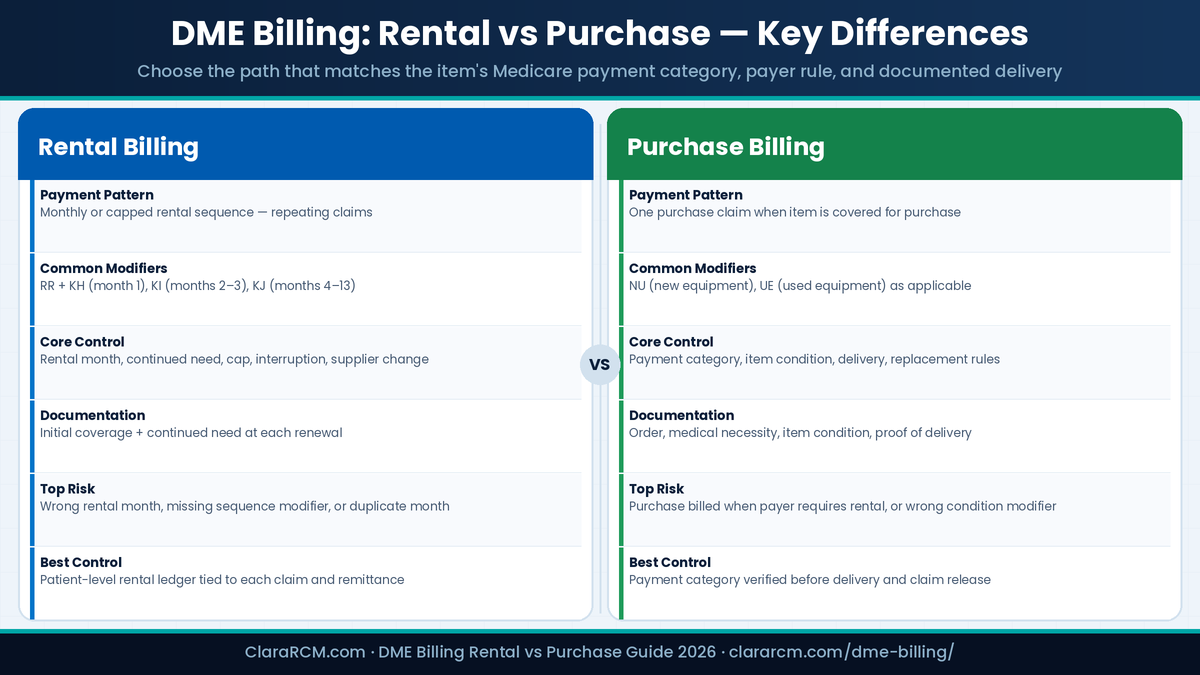
Rental billing requires monthly sequence control with RR, KH, KI, and KJ modifiers. Purchase billing requires the correct payment category, condition modifier, and delivery evidence. Using the wrong path generates automatic denials.
Billing Services for Related Medical Specialties
RCM Services That Support DME Suppliers
Denial Management
Resolve DME denials tied to written orders, medical necessity, authorization, HCPCS codes, modifiers, delivery, refills, and timely filing windows.
Learn more →Billing Audit and Cleanup
Identify and recover revenue from missed rental months, unworked denials, underpayments, refill gaps, and aging AR balances across your DME book.
Learn more →Payment Posting
Post ERA and EOB remittances, flag payment variances against expected amounts, and identify underpayments for follow-up before they age out.
Learn more →Provider Credentialing
Maintain PECOS enrollment, update DMEPOS supplier numbers, and manage payer credentialing to keep claims from denying at the enrollment level.
Learn more →DME Billing Questions: Medicare, Written Orders, Rentals, Refills, and Denials
What is DME billing?
DME billing is the revenue cycle process for durable medical equipment, prosthetics, orthotics, and supplies. It connects eligibility verification, supplier enrollment, medical necessity documentation, standard written orders, face-to-face requirements, prior authorization, HCPCS code selection, modifier application, proof of delivery, rental sequencing, refill controls, payment posting, denial management, and accounts receivable — from the point of the written order through final payment and AR resolution.
How does Medicare define durable medical equipment?
Medicare defines durable medical equipment as items that can withstand repeated use, serve a medical purpose, are useful only to a person who is sick or injured, are appropriate for use in the home, and have an expected useful life of at least three years. The item must also be reasonable and necessary for the diagnosis or treatment of the patient's condition, and the patient must have a valid prescription from a qualifying practitioner. See the CMS DME Coverage page for current policy.
What documentation is required for a Medicare DME claim?
A Medicare DME claim typically requires a standard written order with all required elements (item, beneficiary, order date, prescribing practitioner, and signature), medical record support for coverage and medical necessity, any required face-to-face encounter completed within the applicable time window, a written order before delivery for items on the WOPD list, signed proof of delivery, and refill evidence for recurring supplies. Specific requirements vary by item, HCPCS code, and payer. ClaraRCM's eligibility and verification team validates these before every claim.
What is the difference between an SWO and a WOPD?
A standard written order (SWO) identifies the beneficiary, the item ordered, the order date, the prescribing practitioner, and includes a practitioner signature — it is required for all Medicare DMEPOS items as a condition of payment. A written order before delivery (WOPD) is an additional timing requirement for specific items on the CMS WOPD list: the supplier must receive the qualifying signed order before delivering those items, not after. Not all DME requires a WOPD, but all Medicare DME requires a valid SWO.
How is DME rental billing different from purchase billing?
Rental billing creates repeated monthly claims and requires correct rental modifiers (RR, KH, KI, KJ), sequence tracking, continued need documentation at each renewal, and capped rental management when applicable. Purchase billing creates one claim and depends on the item's Medicare payment category, the correct condition modifier (NU for new, UE for used), and proof of delivery. The Medicare payment category for the item — not the supplier's or patient's preference — determines the correct billing path. Using the wrong path generates automatic denials.
Which modifiers are most important in DME billing?
Key Medicare DME modifiers include RR (rental), NU (new equipment purchase), UE (used equipment purchase), KH (first month of the capped rental period), KI (second and third months), KJ (months 4 through 13 of the capped rental period), KX (required documentation is on file and policy requirements are met), GA (advance beneficiary notice of noncoverage is on file), and GZ (item is expected to be denied as not reasonable and necessary). The correct modifier depends on the item, the rental month, the payment category, and the beneficiary's specific situation.
When can a DME supplier ship refill supplies under Medicare?
Medicare requires that the supplier contact the beneficiary before each refill shipment to confirm that the beneficiary still needs the item and wants it delivered. CMS specifically prohibits automatic refill shipping based on a calendar schedule without a documented beneficiary contact. The contact must be documented within the permitted time window before each refill, and delivery cannot occur earlier than the applicable advance shipment period — typically no more than 10 days before the end of the current supply period. Missing refill contact documentation is a leading cause of recurring supply denials.
Why are DME claims denied more often than other Medicare claims?
DME claims have higher denial rates because they require documentation from multiple sources that must all align: the prescribing physician, the clinical medical record, the supplier's delivery records, and the claim itself. Common denial causes include missing or unsigned written orders, unsupported medical necessity, absent face-to-face encounter, delivery before the required order was in hand, incorrect HCPCS code or modifier, wrong rental month in the sequence, missing proof of delivery, refill shipment timing errors, prior authorization gaps, and PECOS enrollment issues. ClaraRCM's denial management team tracks all DME denials by root cause and feeds findings back into pre-submission controls.
How does proof of delivery affect a Medicare DME claim?
Proof of delivery confirms that the billed item was actually received by the beneficiary and connects the item description, quantity, delivery date, and recipient signature to the claim. Medicare requires that proof of delivery be maintained in the supplier's records and made available on request. Missing, incomplete, or inconsistent proof of delivery can result in claim denial or post-payment recoupment even when the written order and medical necessity documentation are otherwise complete. ClaraRCM reconciles proof of delivery against each claim line before submission.
Is outsourcing DME billing worth the cost?
Outsourcing DME billing is typically cost-effective when a supplier needs stronger written order intake controls, prior authorization management, HCPCS and modifier accuracy, rental sequencing, refill documentation, proof of delivery reconciliation, denial appeals, and AR management. The outsourced fee (typically 4–8% of net collections) compares favorably against the true cost of in-house billing when you account for salary, benefits, software, coding training, and revenue lost to unmanaged denials and expired appeal windows. ClaraRCM's free DME billing audit includes a side-by-side cost comparison specific to your program.