
Payment Posting Services for U.S. Medical Practices
Payment posting records payer and patient payments, contractual adjustments, denial and remark codes, recoupments, and secondary-payer details in the billing system. Accurate posting also reconciles remittances to deposits, identifies exceptions, and sends underpayments, denials, and unmatched cash to the correct follow-up queue.
ClaraRCM combines ERA and EOB posting with deposit reconciliation and exception review so balances move to patients, secondary payers, AR follow-up, or denial management only after the remittance is interpreted correctly.
Get Your Free Posting Review
Send your details and ClaraRCM will review where payments, denials, adjustments, and patient balances may be getting posted incorrectly.
What Is Payment Posting in Medical Billing?
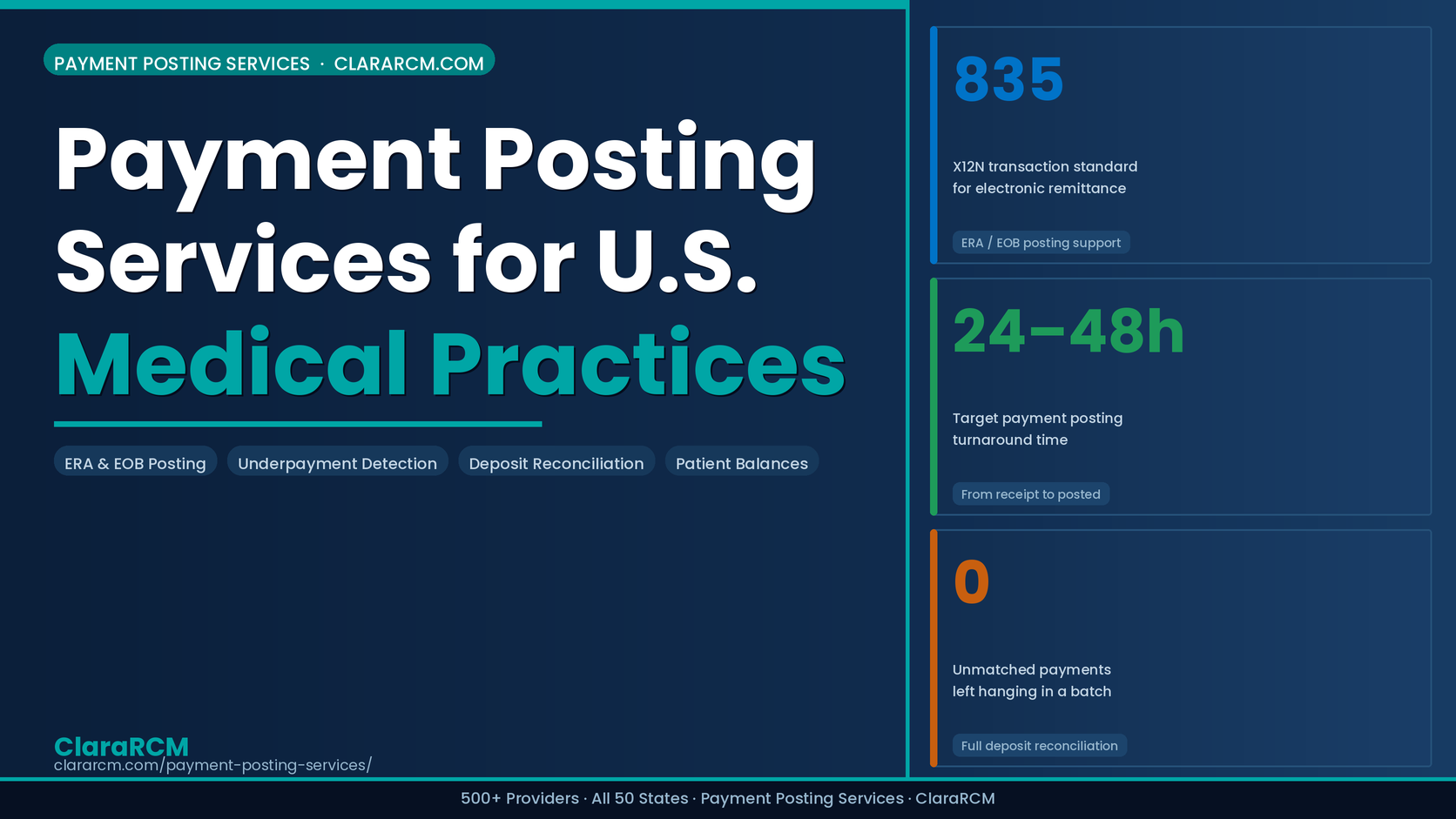
ClaraRCM's payment posting services connect ERA and EOB posting, underpayment detection, deposit reconciliation, and patient balance accuracy into one revenue-protecting workflow.
A payment is not fully posted merely because a dollar amount appears in the account. The paid amount, allowed amount, adjustment group, CARC and RARC codes, patient responsibility, secondary-payer routing, and deposit trace must agree before the remaining balance can move forward safely.
For U.S. practices, accurate payment posting is essential because one wrong adjustment can hide an underpayment, move a balance to the patient too early, leave cash unapplied, or make accounts receivable follow-up chase the wrong issue. ClaraRCM connects posting with claim submission, medical coding support, and full revenue cycle management.
CMS identifies X12 Version 5010 (835) as the adopted electronic remittance advice standard. CMS also explains that the EFT and ERA trace-number segments support payment-to-remittance reassociation. ClaraRCM uses those fields when reconciling deposits and remittances; individual payer manuals, contracts, and remittance details remain controlling. Review the official CMS EFT and remittance advice operating-rules guidance.
Payment Variance Calculator for ERA and EOB Posting
Enter expected allowed amount, actual payer paid amount, total claims submitted, and total denials. Your payment variance and denial rate calculate instantly with no reload.
Planning tool only. Thresholds are ClaraRCM internal review ranges, not national benchmarks or a determination that money is owed.
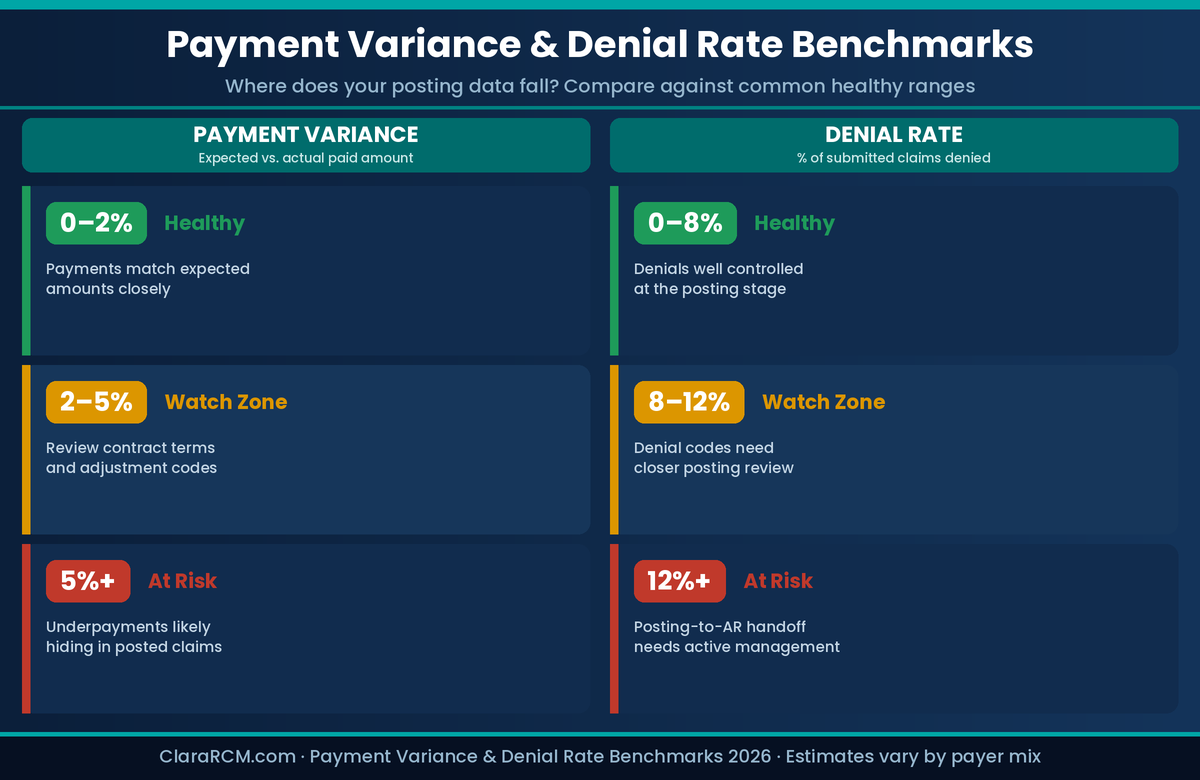
Use these ClaraRCM internal planning thresholds to decide where remittance and claim-level review may be useful. They are not national benchmarks.
Want ClaraRCM to Review These Posting Numbers?
Send your calculator results and our team will follow up with a free payment posting and reconciliation review.
Our Payment Posting Process, Step by Step
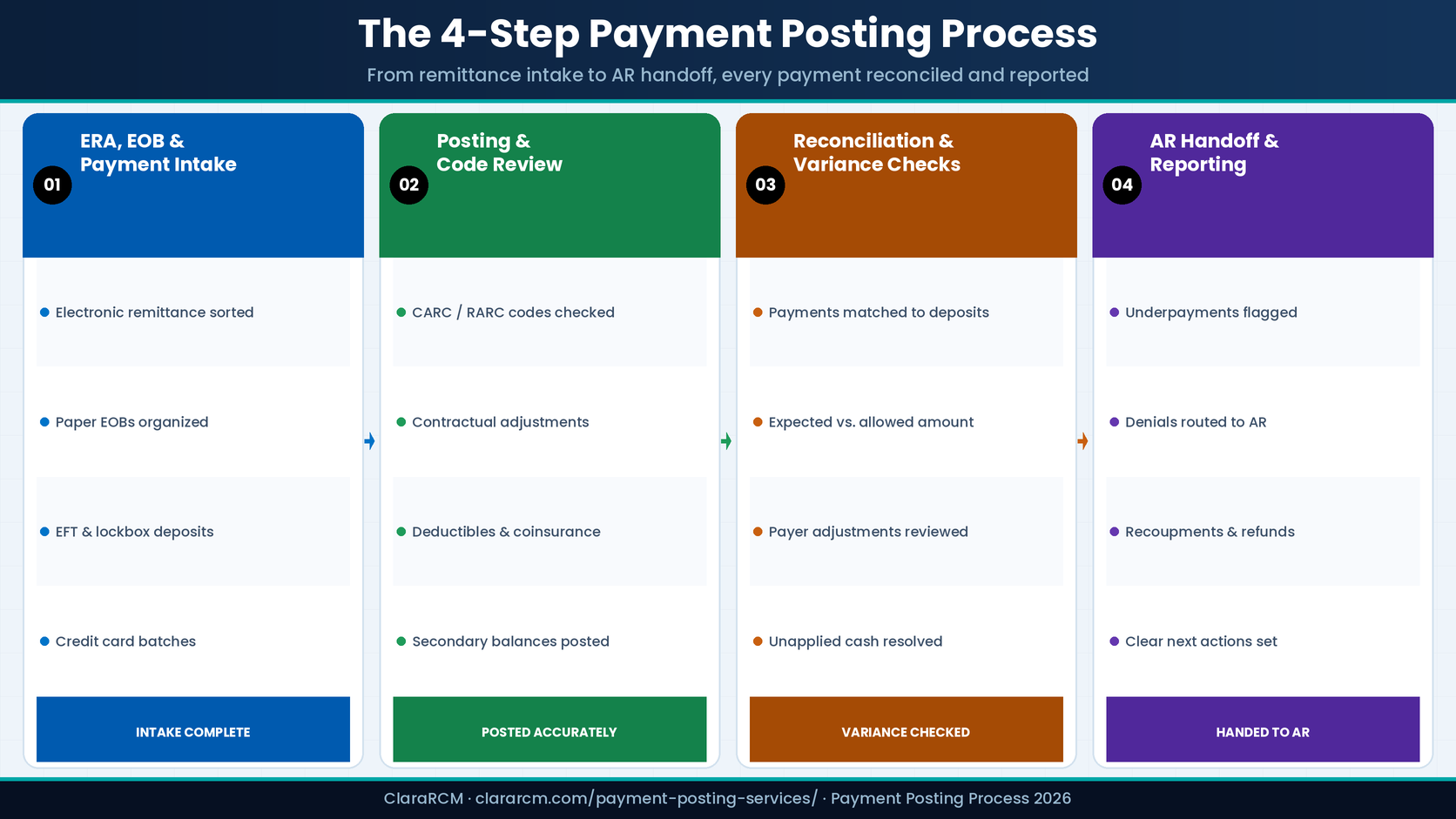
ClaraRCM's four-step payment posting process: remittance intake, posting and code review, reconciliation and variance checks, and AR handoff with reporting.
ERA, EOB & Payment Intake
We organize electronic remittance advice, paper EOBs, EFT details, patient payments, credit card batches, and lockbox deposits.
Posting & Code Review
Payments, contractual adjustments, CARC/RARC codes, denials, deductibles, coinsurance, copays, and secondary balances are posted accurately.
Reconciliation & Variance Checks
We match posted payments against deposits, expected allowed amounts, payer adjustments, and unresolved unapplied cash.
AR Handoff & Reporting
Underpayments, denials, recoupments, refunds, and unresolved balances move to AR follow-up or denial management with clear next actions.
Payment Posting Support Built for Clean AR and Accurate Revenue
ERA and EOB Posting Expertise
We handle electronic and paper remittance posting with attention to payer reason codes, adjustments, and patient responsibility.
Underpayment Detection
Payments are reviewed against expected reimbursement so contract variances do not get posted as fully resolved accounts.
Denial Detail That Drives Action
Denial and remark codes are posted in a way that supports appeals, corrected claims, and payer follow-up.
Patient Balance Accuracy
Deductibles, copays, coinsurance, secondary payer amounts, and adjustments are reviewed before patient billing moves forward.
Deposit Reconciliation
Posted payments are matched to EFTs, checks, and daily deposits so unapplied cash and missing batches are visible.
Connected RCM Workflow
Posting outcomes flow into AR follow-up, denial management, reporting, and patient collections instead of staying isolated.
What Changes After ClaraRCM Manages Your Payment Posting
These operational improvements reflect what U.S. practices typically target when posting, reconciliation, and AR follow-up are connected.
| Metric | Before | After ClaraRCM |
|---|---|---|
| Posting Turnaround | Delayed batches and uneven cash visibility | Target 24-48 hour posting workflow |
| Unapplied Cash | Balances sit unresolved across batches | Tracked, reconciled, and assigned next action |
| Underpayments | Often posted as paid without review | Flagged for payer follow-up and contract review |
| Patient Balances | Incorrect transfers create billing complaints | Deductible, copay, coinsurance, and secondary amounts reviewed |
Actual results vary by payer mix, practice management system, volume, ERA quality, contract terms, and existing backlog.
Auto Payment Posting vs. ClaraRCM Posting Support
Auto-posting is helpful, but it can miss underpayments, adjustment errors, patient responsibility issues, and denials that need human follow-up.
Auto-Posting Alone
- Posts ERA data without always reviewing contract variance
- Can leave unapplied cash, takebacks, or reversals unresolved
- May transfer incorrect balances to patients
- Does not always route denials to AR or appeal workflows
ClaraRCM Payment Posting
- Combines automation with human review of exceptions
- Flags underpayments, recoupments, denials, and unusual adjustments
- Protects patient balance accuracy before statements go out
- Connects posting outcomes to AR follow-up and denial management
Payment Posting Services by Specialty
Payment patterns vary by payer mix, benefit design, procedure type, and patient responsibility. ClaraRCM adapts posting workflows to your specialty.
Payment Posting Services FAQ
What are payment posting services in medical billing?
Payment posting services enter and reconcile insurance payments, patient payments, contractual adjustments, denial codes, remark codes, refunds, recoupments, and secondary payer details in the billing system.
Why is accurate payment posting important for U.S. practices?
Accurate posting keeps AR clean, protects patient balance accuracy, reveals underpayments, supports denial management, and gives practice leaders reliable cash and revenue reports.
What is ERA payment posting?
ERA payment posting uses the electronic remittance advice, commonly the ASC X12N 835 transaction, to post payer payments, adjustments, denials, and patient responsibility into the practice management system.
What is the difference between ERA posting and EOB posting?
ERA posting uses electronic remittance files, while EOB posting uses paper or PDF explanations of benefits. Both require careful review of paid amounts, adjustments, denial codes, and patient responsibility.
Can payment posting help find underpayments?
Yes. When posted payments are compared with expected allowed amounts, contract terms, and payer adjustments, underpayments can be flagged for AR follow-up instead of being missed.
Does ClaraRCM post patient payments?
Yes. ClaraRCM can support patient payment posting, including copays, deductibles, coinsurance, credit card payments, statement payments, and balance reconciliation.
How does payment posting affect denial management?
Payment posting captures denial and remark codes. If those codes are posted clearly, denial management can appeal, correct, or route claims faster with fewer missing details.
What is unapplied cash in medical billing?
Unapplied cash is money received but not matched to the correct patient, claim, payer, or account. It should be reconciled quickly so revenue reports and patient balances stay accurate.
Should payment posting be outsourced or handled in-house?
Outsourcing is useful when in-house teams are behind on posting, missing underpayments, struggling with ERA exceptions, or transferring inaccurate balances to patients.
What information do I need for a free posting review?
Start with aggregate, de-identified information such as payment volume, posting lag, unapplied-cash totals, denial rate, or reconciliation concerns. Do not send PHI through the website form. If claim-level materials are needed, ClaraRCM will arrange an appropriate secure intake method.