
Telehealth Billing Services for Virtual Visits, POS 02, POS 10, Modifier 95, and Denial Recovery
Telehealth billing is the process of converting virtual care documentation into clean claims with the correct CPT or HCPCS code, place of service (POS 02 or POS 10), modifier (95 or FQ), modality, patient location, provider location, and payer coverage rule. Telehealth claims deny more often than in-person claims because every payer treats virtual care differently — the same E/M code can require a different POS code, modifier, and documentation trail depending on whether the visit was video, audio-only, portal-based, or a follow-up. ClaraRCM builds payer-specific telehealth policy checks directly into the billing workflow for practices across all 50 states, targeting a 97% clean claim rate on virtual visit claims.
ClaraRCM provides telehealth billing services for U.S. medical practices across all 50 states. Our team handles virtual visit coding, POS 02, POS 10, modifier 95, audio-only billing rules, payer policy checks, denial follow up, payment posting, and AR recovery.
Updated for 2026 Medicare telehealth policy, POS 02 and POS 10 rules, virtual visit documentation, audio-only billing, and payer denial prevention.
✓ Last updated: July 2026Get a Free Telehealth Billing Audit
See where virtual visit coding, POS errors, modifier gaps, audio-only rules, and payer denials are slowing reimbursement.
What Is Telehealth Billing, and Why Do Virtual Visit Claims Get Denied?
ClaraRCM's telehealth billing services build payer-specific POS, modifier, and audio-only policy checks directly into the billing workflow to prevent the most common virtual visit denials.
Telehealth billing is the process of converting virtual care documentation into clean claims with the right CPT or HCPCS code, POS code, modifier, modality, patient location, provider location, payer coverage rule, and medical necessity support.
Telehealth claims are easy to underbill or deny because every payer treats virtual care differently. A visit may be video, audio-only, portal based, asynchronous, remote monitoring, or follow up care, and each route can require a different code, place of service, modifier, consent note, and documentation trail.
Our team checks payer policy, telehealth eligibility, visit type, patient location, provider location, modifier support, audio-only rules, medical necessity, and timely filing before claims move into AR.
| Problem | ClaraRCM Fix |
|---|---|
| Wrong POS code used for patient home or non-home location | POS 02 and POS 10 validation before claim submission |
| Modifier 95 missing when payer requires synchronous telehealth reporting | Payer specific modifier checklist for each virtual visit |
| Audio-only visit denied because documentation does not support the service | Modality, time, consent, and medical necessity review |
| Commercial payer does not cover the virtual version of the service | Telehealth benefit and payer policy check before billing |
| Provider licensure or patient location issue triggers compliance risk | Patient state and provider enrollment review built into workflow |
Telehealth Denial and Underpayment Calculator
Telehealth practices lose revenue when virtual visits are denied for POS errors, missing modifiers, unsupported audio-only billing, payer coverage mismatches, or weak documentation. Estimate annual revenue exposure from preventable telehealth claim problems.
This estimate is directional and depends on payer mix, contract rates, patient location, visit type, documentation quality, modifier rules, and appeal success.
Send Us Your Calculator Results
Share your inputs and our team will review where telehealth denials, POS errors, modifier gaps, and aging AR may be affecting reimbursement.
Telehealth CPT and HCPCS Code Reference Table
Telehealth billing depends on the covered service, payer policy, place of service, modifier, modality, and documentation. The approximate Medicare ranges below reflect common professional claim direction under the Physician Fee Schedule and can vary by locality and date of service. Last updated: July 2026.
| Code | Short Description | Approx. Medicare Range | Billing Notes |
|---|---|---|---|
| 99202 | New patient office or outpatient E/M, straightforward | $70 to $90 | Use when payer allows the service by telehealth and documentation supports new patient level |
| 99203 | New patient office or outpatient E/M, low complexity | $105 to $135 | Common virtual new patient visit when covered by payer policy |
| 99204 | New patient office or outpatient E/M, moderate complexity | $160 to $210 | Requires strong MDM or time documentation |
| 99205 | New patient office or outpatient E/M, high complexity | $220 to $285 | High documentation and medical necessity burden |
| 99212 | Established patient office or outpatient E/M, straightforward | $25 to $45 | Lower level virtual follow up when supported |
| 99213 | Established patient office or outpatient E/M, low complexity | $80 to $110 | Common telehealth follow up visit code |
| 99214 | Established patient office or outpatient E/M, moderate complexity | $120 to $170 | Common chronic condition or medication management telehealth code |
| 99215 | Established patient office or outpatient E/M, high complexity | $170 to $225 | Requires high level MDM or time support |
| 99421 | Online digital E/M, 5 to 10 cumulative minutes over 7 days | $15 to $25 | Patient initiated portal based service |
| 99422 | Online digital E/M, 11 to 20 cumulative minutes over 7 days | $30 to $45 | Document cumulative time and clinical work |
| 99423 | Online digital E/M, 21 or more cumulative minutes over 7 days | $50 to $70 | Not the same as a live video visit |
| G2012 | Brief communication technology based service | $14 to $20 | Virtual check-in style service when payer rules are met |
| G2252 | Brief communication technology based service, 11 to 20 minutes | $25 to $40 | Requires careful timing and initiation documentation |
| POS 02 | Telehealth provided other than in patient's home | N/A | Location code for professional claims |
| POS 10 | Telehealth provided in patient's home | N/A | Location code for professional claims |
| Modifier 95 | Synchronous telemedicine service by real time audio and video | N/A | Use when required by payer policy |
| Modifier FQ | Audio-only communication technology | N/A | Use only when payer policy requires audio-only reporting |
Telehealth payment depends on payer policy, covered service list, provider type, patient location, modality, modifier rules, and documentation.
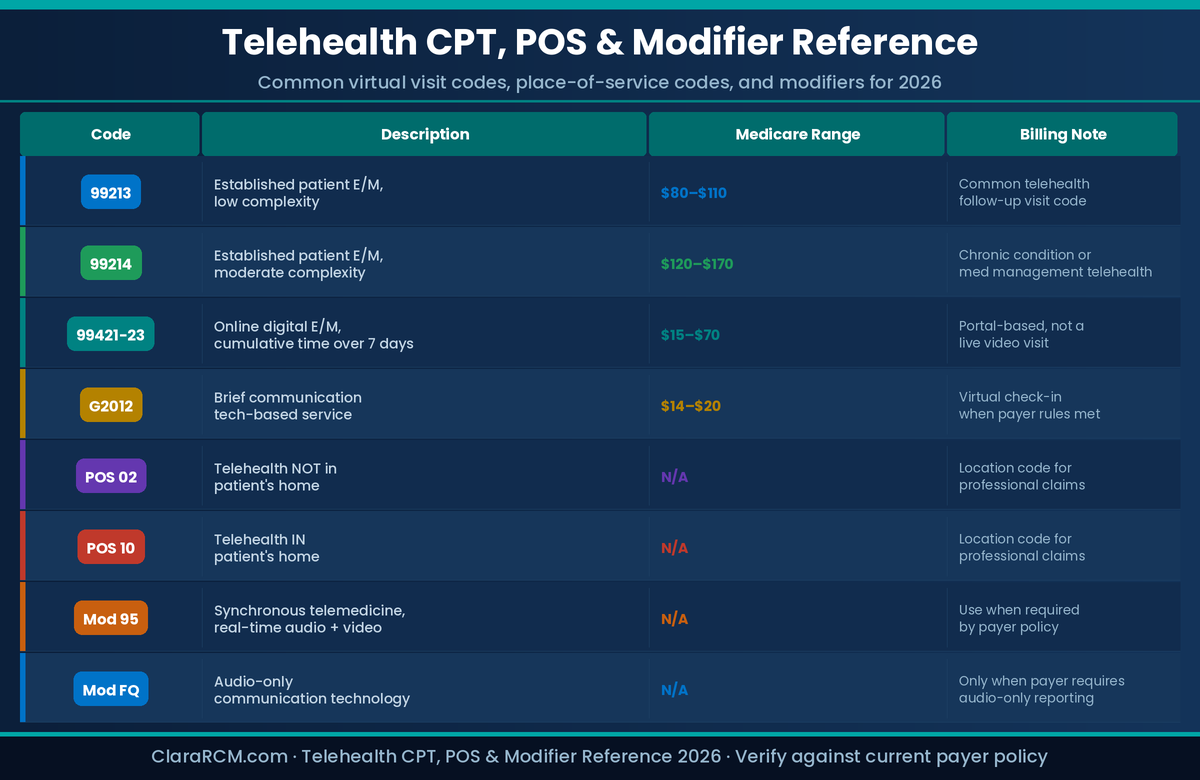
Common telehealth CPT and HCPCS codes, POS 02/10 place-of-service codes, and modifier 95/FQ reference with approximate 2026 Medicare direction. Verify against current payer policy before billing.
How ClaraRCM Handles Telehealth Billing
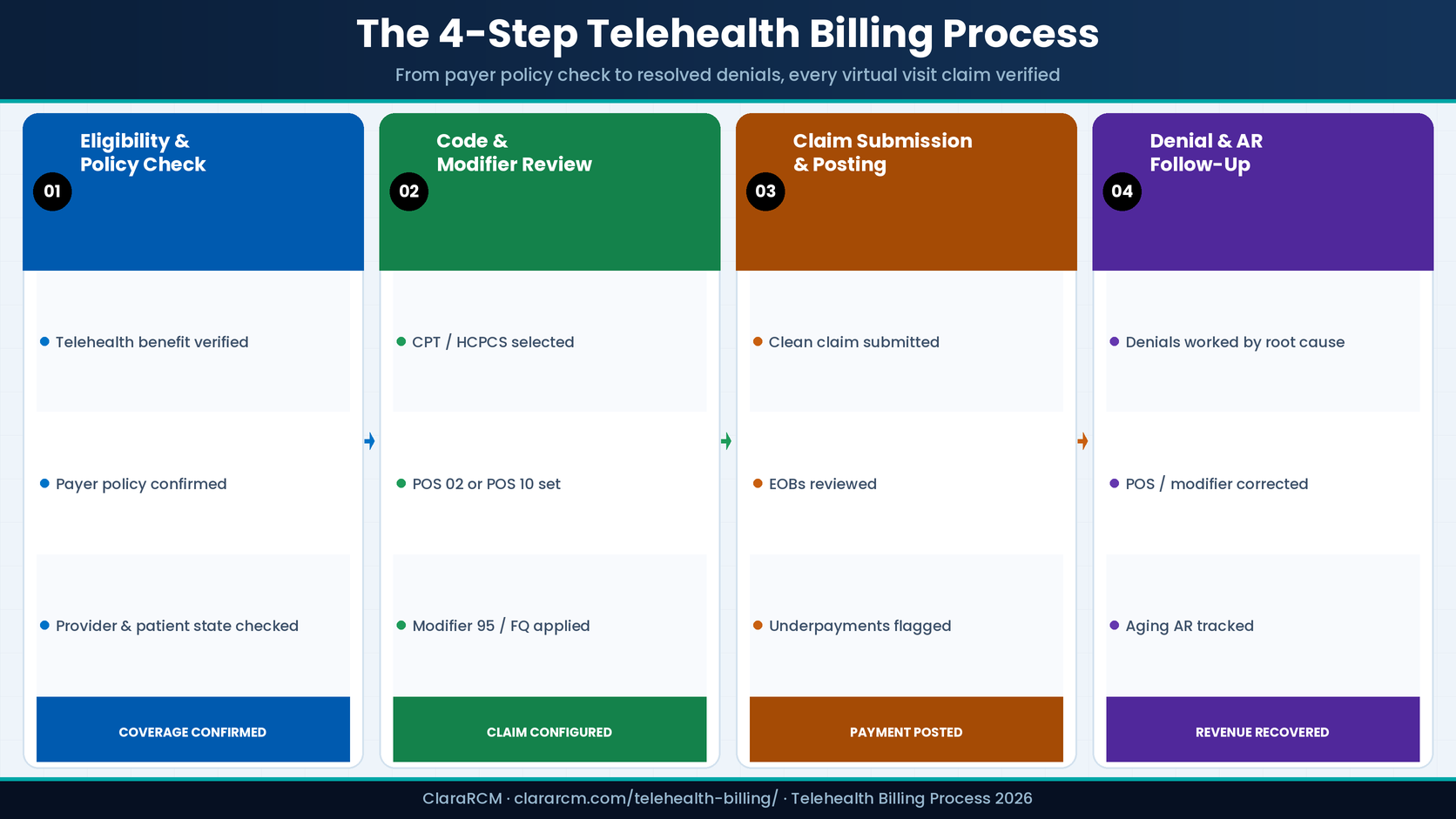
ClaraRCM's four-step telehealth billing process: eligibility and policy check, code and modifier review, claim submission and posting, and denial and AR follow-up.
Eligibility and Policy Check
We verify active coverage, telehealth benefits, payer policy, patient location rules, provider eligibility, and virtual visit coverage before billing.
Code and Modifier Review
We review CPT, HCPCS, POS 02, POS 10, modifier 95, audio-only modifiers, consent notes, modality, time, and medical necessity.
Claim Submission and Posting
We submit clean telehealth claims, post payments, review EOBs, flag underpayments, and correct payer specific virtual care rejections.
Denial and AR Follow Up
We work denied and unpaid telehealth claims by root cause so POS, modifier, eligibility, and audio-only issues do not keep repeating.
Why Telehealth Providers Choose ClaraRCM
Telehealth Specific Billing
We understand POS 02, POS 10, modifier 95, audio-only visits, virtual check-ins, e-visits, and payer specific virtual care rules.
97% Clean Claim Rate
Our process is built around cleaner claims, fewer preventable rejections, and faster payer acceptance.
Payer Policy Control
We track whether each payer covers the virtual version of the service and what modifier or POS rule applies.
Documentation Support
We check visit modality, patient consent, patient location, provider location, time, MDM, and medical necessity.
All 50 States
ClaraRCM supports 500 plus providers nationwide, including virtual care practices and hybrid care models.
35% Average AR Reduction
We combine denial follow up, payer calls, EOB review, appeal workflows, and aging AR cleanup to reduce unpaid balances.
Before ClaraRCM vs. After ClaraRCM
| Metric | Before | After ClaraRCM |
|---|---|---|
| Clean claim rate | Frequent POS, modifier, audio-only, and payer policy errors | 97% clean claim rate |
| Collection ratio | Inconsistent collection on denied or underpaid virtual visits | 98.5% collection ratio |
| Accounts receivable | Aging telehealth claims stuck past 60 to 90 days | 35% average AR reduction |
| Days to reimbursement | Delayed by payer rule mismatch or missing virtual visit documentation | 14 days average |
| Telehealth compliance | Manual tracking of patient location, modality, and modifier requirements | Claim level telehealth review built into workflow |
Figures reflect ClaraRCM aggregate client performance metrics across specialties. Individual results vary by payer mix, claim volume, documentation quality, and starting AR baseline.
Telehealth Billing vs. In-Person Billing: What Is Actually Different
Telehealth billing and in-person billing may use the same E/M code family, but telehealth claims require additional attention to modality, patient location, provider location, payer coverage, POS code, modifier rules, and consent documentation.
| Factor | Telehealth Billing | In-Person Billing |
|---|---|---|
| Place of service | Often POS 02 or POS 10 depending on patient location | Usually office, facility, home, or other physical site POS |
| Modifier focus | Modifier 95, GT, FQ, or payer specific virtual care modifier | Modifier 25, 59, or specialty specific modifiers as needed |
| Documentation focus | Modality, patient consent, patient location, provider location, time, MDM, and medical necessity | History, exam when relevant, MDM, time, plan, and medical necessity |
| Common denial trigger | Non-covered virtual service, wrong POS, missing modifier, unsupported audio-only visit | Eligibility, authorization, coding level, diagnosis support, or modifier issue |
| Best billing control point | Telehealth benefit check plus modality and POS review before submission | Eligibility verification plus coding and payer rule review before submission |
Billing Services for Related Specialties
Related ClaraRCM Services
Denial Management and AR Recovery
Resolve telehealth denials tied to POS errors, missing modifiers, payer rules, and audio-only documentation.
Learn more →RPM and CCM Billing
Support for practices combining virtual visits with monitoring and chronic care management workflows.
Learn more →Mental Health Billing
Telehealth billing support for behavioral health visits, therapy sessions, psychiatric care, and virtual follow ups.
Learn more →Primary Care Billing
Support for hybrid care models that combine office visits, virtual visits, chronic care, and preventive care.
Learn more →Telehealth Billing: Frequently Asked Questions
What is telehealth billing?
Telehealth billing is the process of coding and submitting claims for virtual healthcare visits. It requires the correct CPT or HCPCS code, place of service, modifier, modality, patient location, provider location, payer policy, medical necessity, and documentation support.
What is the difference between POS 02 and POS 10?
POS 02 is used when telehealth is provided while the patient is not located in the patient's home. POS 10 is used when telehealth is provided while the patient is located in the patient's home. Using the wrong POS code can trigger denials or underpayment.
What modifier is used for telehealth billing?
Modifier 95 is commonly used for synchronous telemedicine services delivered through real time audio and video when payer policy requires it. Some payers may require GT, FQ, or other payer specific modifiers depending on service type and modality.
Why do telehealth claims get denied?
Telehealth claims are commonly denied because the payer does not cover the service virtually, the wrong POS code is used, modifier 95 is missing, audio-only rules are not met, patient location is missing, provider licensure is unclear, or documentation does not support medical necessity.
Does Medicare pay for telehealth visits in 2026?
Medicare telehealth payment depends on current law, the Medicare telehealth services list, provider type, service code, patient location, and CMS billing instructions. CMS updates telehealth services through federal policy and annual payment rulemaking.
Can audio-only visits be billed as telehealth?
Audio-only visits can be billed only when payer policy allows the service and the documentation supports the required modality, time, consent, patient need, and medical necessity. Some payers require specific audio-only modifiers or code families.
What should be documented for a telehealth visit?
A telehealth note should document the visit modality, patient consent when required, patient location, provider location, medical necessity, history, assessment, plan, time or MDM when relevant, and any payer specific telehealth requirements.
Is telehealth billing paid the same as in-person billing?
Telehealth payment depends on payer policy. Some payers reimburse certain telehealth services at a rate similar to in-person care, while others apply different rates, POS rules, modifier rules, service limitations, or medical necessity requirements.
What is the difference between telehealth billing and RPM billing?
Telehealth billing usually reports a virtual encounter between a patient and provider. RPM billing reports remote collection and management of physiologic data, device setup, data transmission, and treatment management services. The code sets and documentation requirements are different.
How is telehealth billing different from in-person billing?
Telehealth billing requires extra claim details such as modality, POS 02 or POS 10, telehealth modifiers, patient location, provider location, consent when required, and payer virtual care coverage. In-person billing focuses more on the physical location of care and standard service documentation.
Do telehealth providers need to check state licensure rules?
Yes. Telehealth providers should confirm that the clinician is allowed to treat the patient based on the patient's location and applicable state licensure rules. Billing teams should capture patient location because it affects compliance, payer policy, and claim support.
Is outsourcing telehealth billing worth it for a virtual care practice?
Outsourcing telehealth billing can be worth it when a practice is losing time or revenue to payer policy changes, POS errors, modifier denials, audio-only documentation gaps, underpayments, payment posting issues, or aging AR that internal staff cannot consistently follow up.